Case Study — Hospital Management System
A next-generation Hospital Management System
Replacing a localhost-only legacy system with cloud HMS, a patient portal, and the analytics a growing hospital needs to run on more than gut feeling.
Client identity and commercial terms are withheld here. The architecture, the problem analysis and the module plan below are exactly what we designed for them.
The hospital
A NABH-accredited super-specialty hospital — 100 beds today, with a planned expansion to 250 — running 12 departments including cardiology, neurosurgery, orthopaedics and nephrology. It's the region's referral point for a multi-state catchment area, and it was running its entire operation on a hospital management system that never left the building.
What we observed
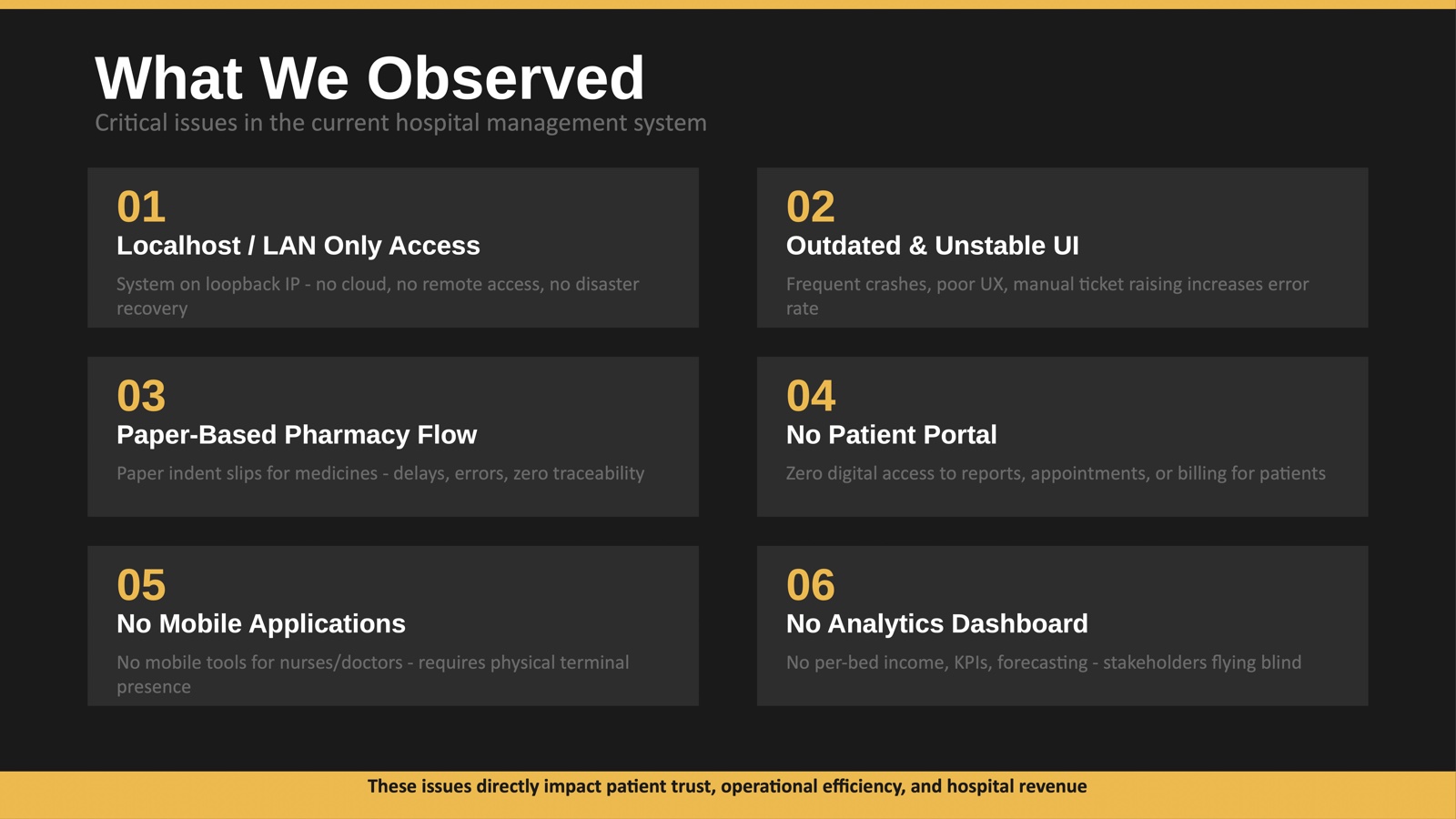
Critical issues in the current hospital management system, found before any design work started.
Localhost / LAN-only access
The existing system sat on a loopback IP — no cloud, no remote access, no disaster recovery.
Outdated & unstable UI
Frequent crashes, poor UX, manual ticket-raising that pushed the error rate up rather than down.
Paper-based pharmacy flow
Paper indent slips for medicines — delays, transcription errors, and zero traceability.
No patient portal
Zero digital access to reports, appointments or billing — every touchpoint required a phone call or a front-desk queue.
No mobile applications
No mobile tools for nurses or doctors — everything required physical presence at a terminal.
No analytics dashboard
No per-bed income, no KPIs, no forecasting — leadership was flying on gut feeling.
The hidden cost of the status quo
None of this shows up as a line item on its own — it shows up as leakage nobody's measuring.
₹15–20L
Estimated revenue leakage per year — billing errors, missed charges, untracked inventory
40%
Nurse time wasted on paper indent processing, manual entries, department walks
0%
Patient retention data — no portal means no feedback loop, no follow-ups
Zero
Data-driven decisions — gut feeling in place of real-time KPIs and forecasting
Public patient reviews already flag long wait times and billing transparency issues — exactly the problems a modern HMS solves, and exactly the kind of feedback that shows up months before it reaches a board meeting.
What good looks like
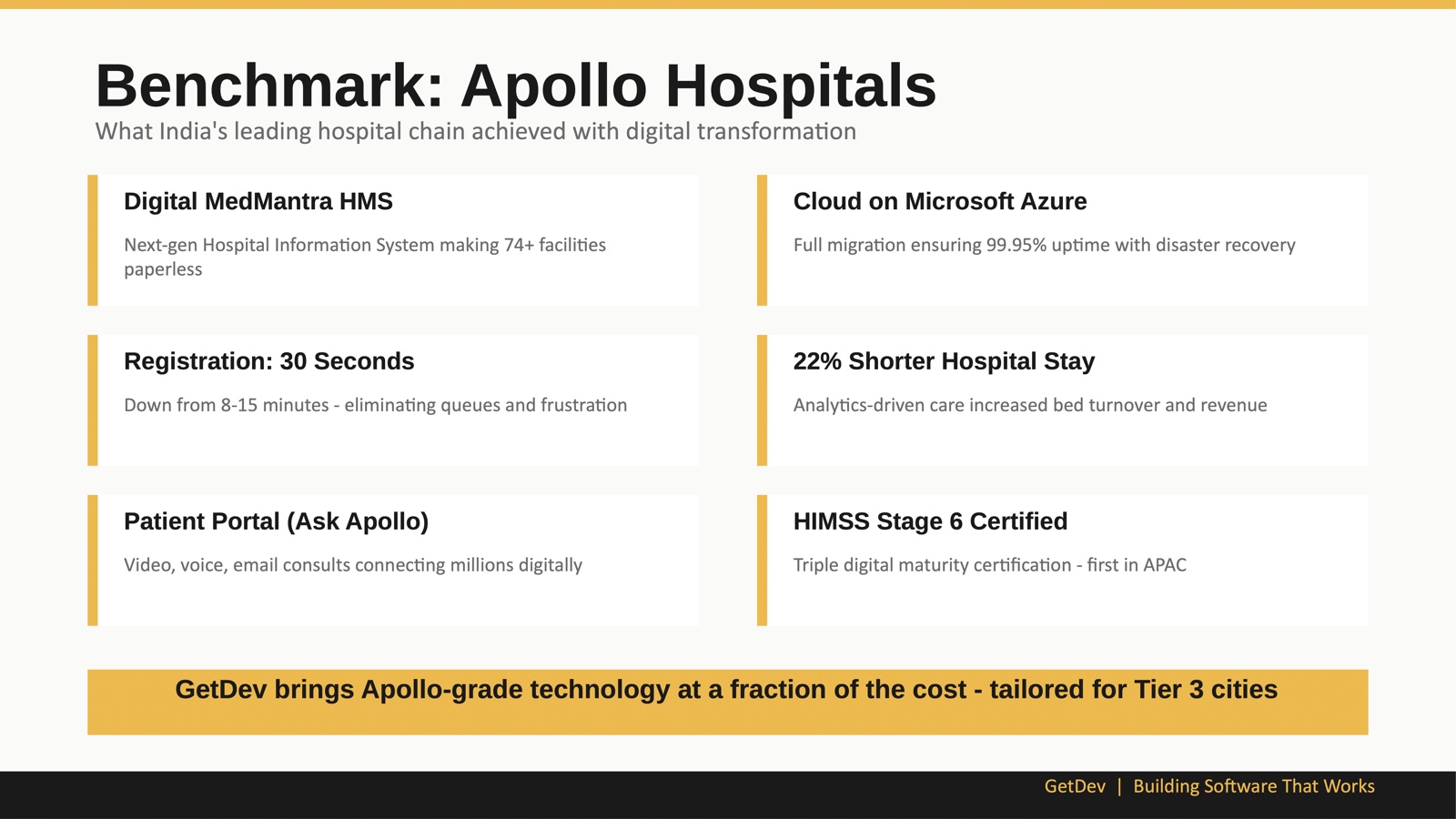
Part of the proposal benchmarked against Apollo Hospitals — India's largest chain, and a useful reference point precisely because their published digital-transformation numbers are public. Nobody expects a 100-bed regional hospital to match Apollo's scale, but the direction — registration measured in seconds not minutes, a patient app, cloud uptime guarantees — is the same regardless of size.
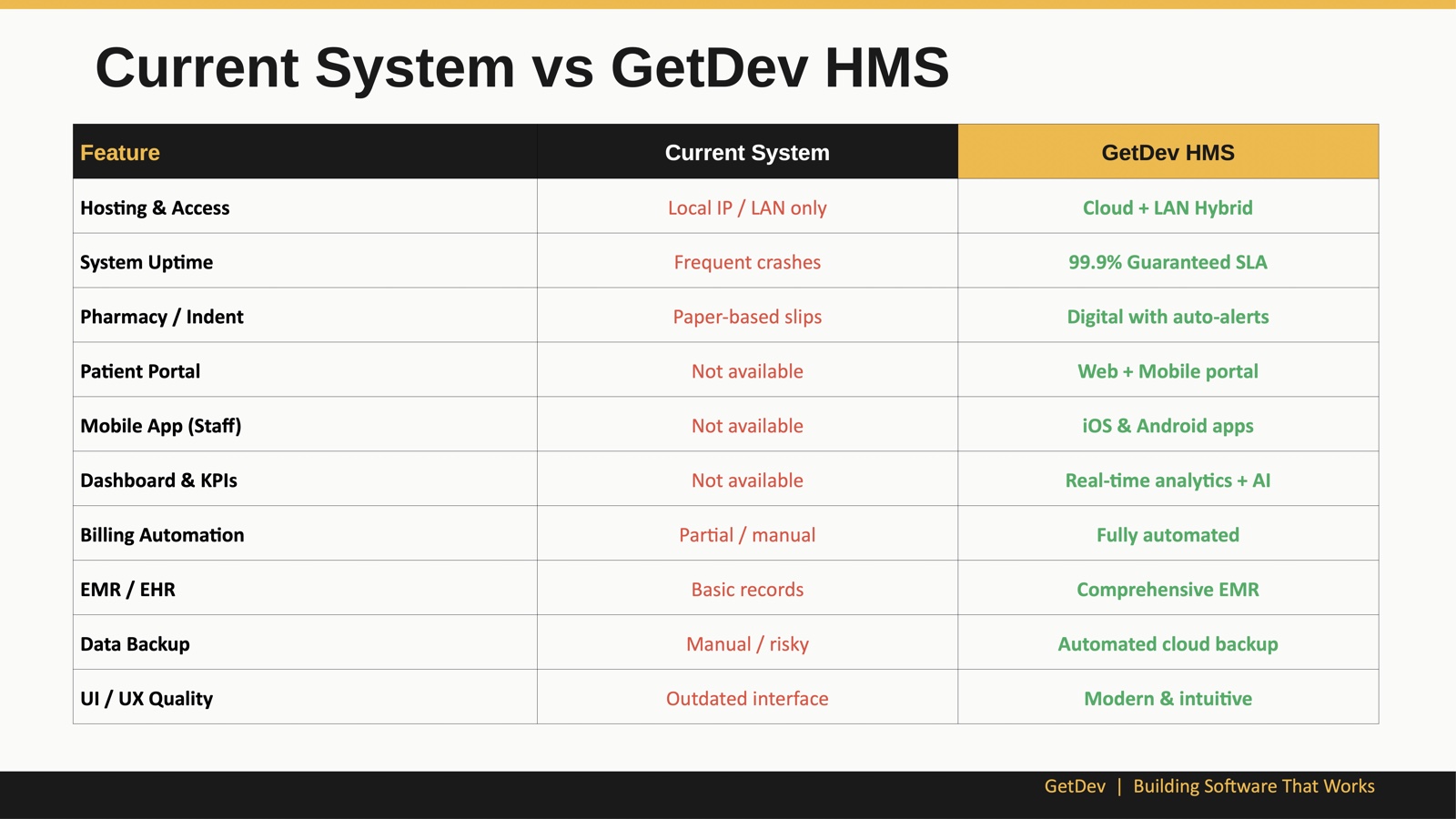
Current system vs. the proposed HMS
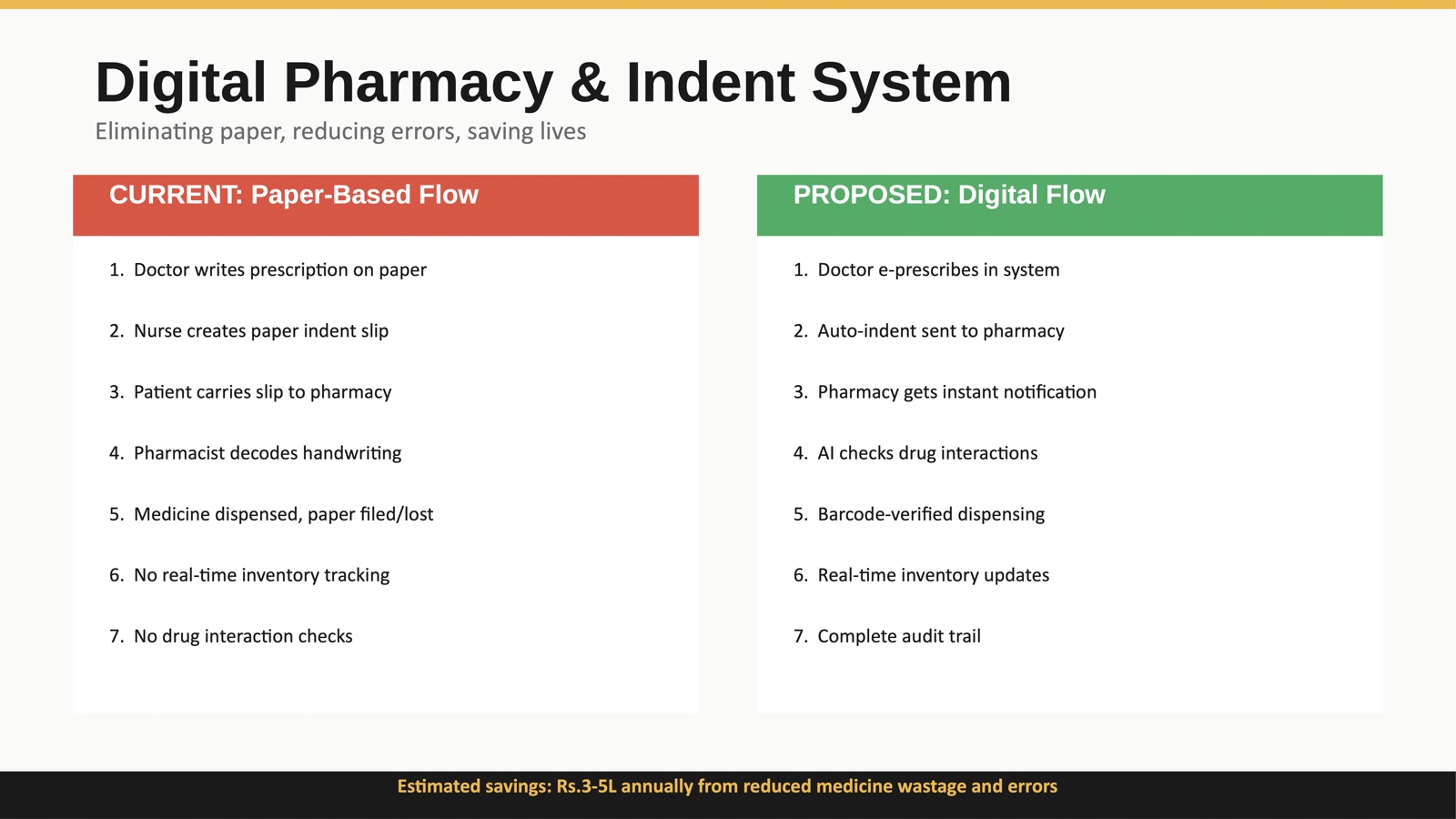
Digital pharmacy & indent system
Current: paper-based flow
- Doctor writes prescription on paper
- Nurse creates paper indent slip
- Patient carries slip to pharmacy
- Pharmacist decodes handwriting
- Medicine dispensed, paper filed/lost
- No real-time inventory tracking
- No drug interaction checks
Proposed: digital flow
- Doctor e-prescribes in system
- Auto-indent sent to pharmacy
- Pharmacy gets instant notification
- AI checks drug interactions
- Barcode-verified dispensing
- Real-time inventory updates
- Complete audit trail
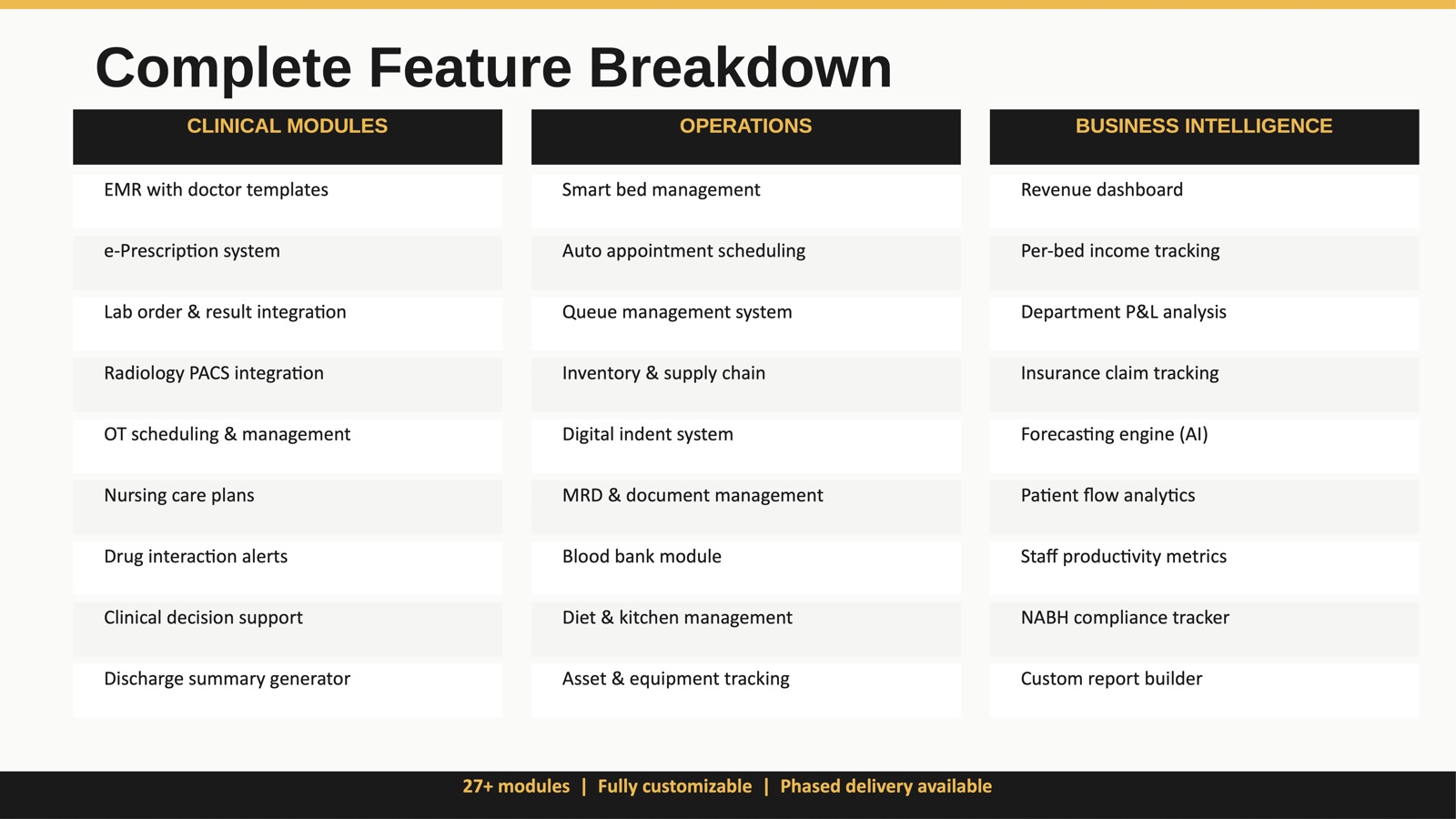
The complete feature breakdown
27+ modules across three groups — clinical, operations, and business intelligence — fully customisable, with phased delivery available.
Patient portal & mobile apps
Online booking, lab reports on demand, digital billing, prescription history and a discharge-summary PDF for patients; real-time vitals, digital indent, nurse task management and bedside charting for staff.
68%
of patients prefer digital booking over calling in
3×
higher patient retention with a portal in place
35%
reduction in front-desk call volume
Being first to market with a real patient app is a meaningful brand differentiator for any regional hospital — most competitors in a tier-2/3 market haven't shipped one yet.
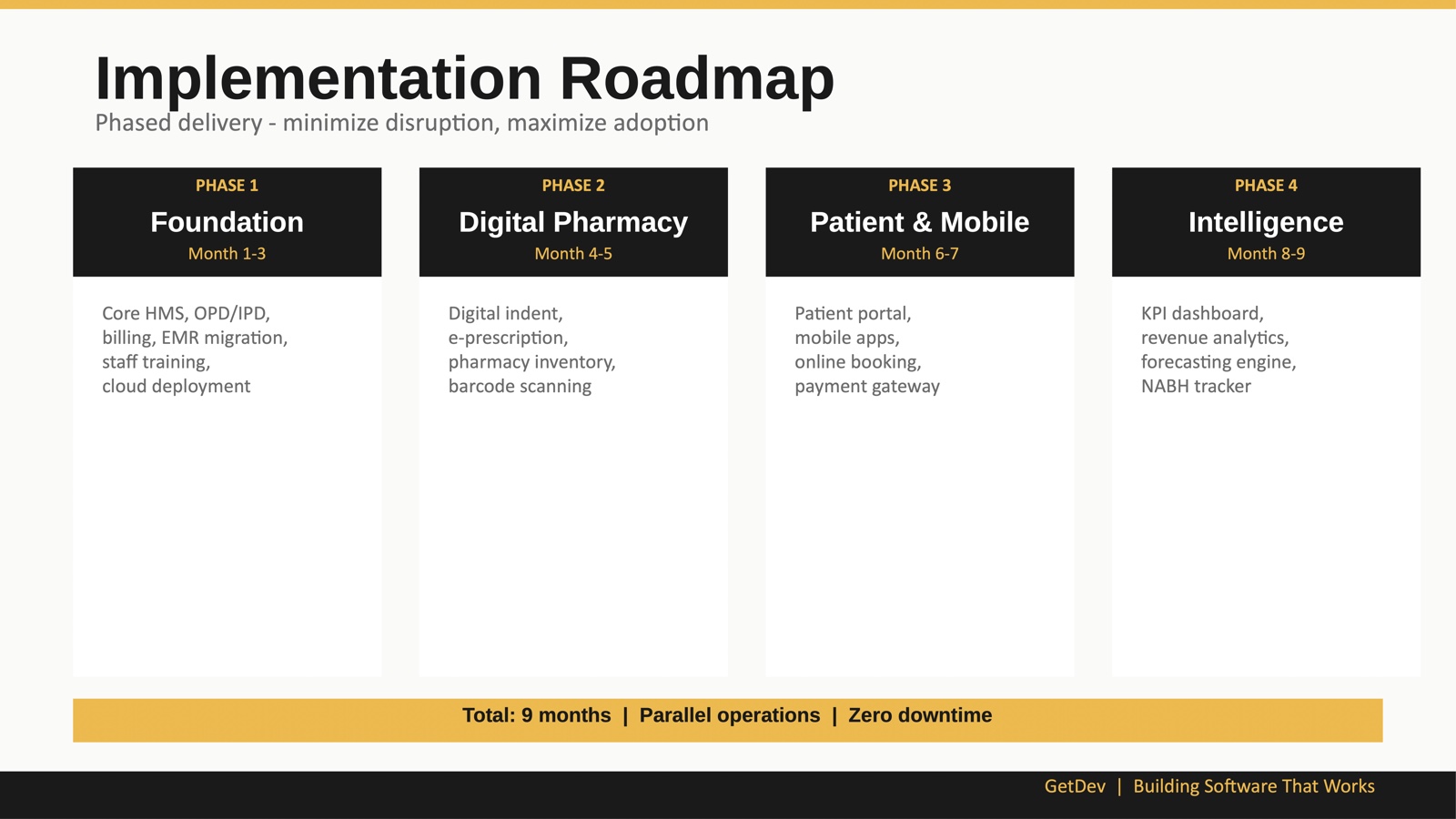
Implementation roadmap
Phased delivery, four stages over nine months, built to minimise disruption to a hospital that can't afford downtime.
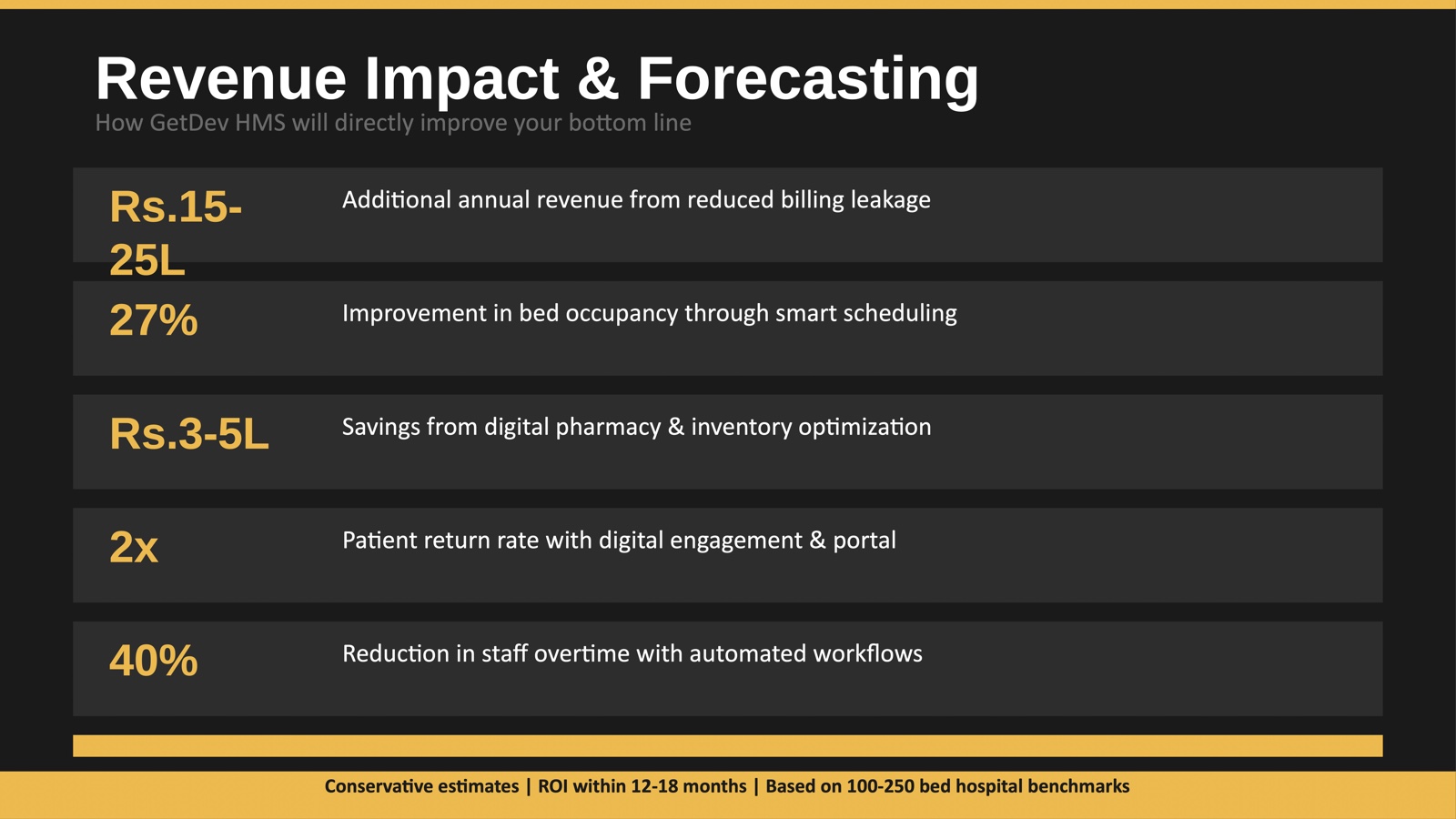
Projected impact
Conservative estimates, based on 100–250 bed hospital benchmarks, with an ROI window of 12–18 months.
₹15–25L
Additional annual revenue from reduced billing leakage
27%
Improvement in bed occupancy through smart scheduling
₹3–5L
Savings from digital pharmacy & inventory optimisation
2×
Patient return rate with digital engagement & a portal
40%
Reduction in staff overtime with automated workflows
Why a focused partner over a large vendor
Dedicated attention
Not ticket #5000 — a project small enough that it gets senior-level involvement, not a rotating support queue.
Custom-built, not boxed
Every module tailored to how the hospital's own staff actually works, not a rigid generic template.
Agile delivery
Working software in weeks, not months — weekly demos, and feedback drives the next sprint.
Long-term partnership
A flexible retainer relationship — the client's success is the reference case, so it's treated that way.
If a hospital or clinic you run is still coordinating patient care over a system that only works inside one building, that's a solvable problem — and one that usually pays for itself faster than people expect.
Ready to Get Started?
Book a free discovery call and let's explore how Dev can accelerate your business with AI-first solutions.
🍪 We use cookies
We use cookies to analyze site traffic and improve your experience. No personal data is sold.