Case Study — Peer-Learning Nonprofit
Website and internal tools for Involve
In a classroom of forty children, one teacher can't give everyone individual attention — but the older children can. Involve trains senior students to teach their juniors.
Who Involve is
Two IIT Madras graduates, Divanshu and Samyak, skipped their campus placements in 2018 to start Involve. A Student Leader, usually aged 12 to 16, works through the year with four or five younger children on foundational reading and maths. The younger children get attention a single teacher can't provide. The senior children learn to lead while doing it.
Involve's peer teaching model was cited in the Economic Survey 2025 as a driver of student-led classrooms under NIPUN Bharat. A research study with Columbia and Harvard is currently running in Bihar. Funders include Acumen, Central Square Foundation, Wells Fargo and the Agency Fund. Maargadarshi is the deep version — 38 schools in Anekal, Karnataka. REACH Government embeds what works into public systems, across 2,353 schools in Karnataka, 3,500+ in Bihar and 1,263 in Uttar Pradesh. Their goal is 10 million children by 2030.
The public website
involveedu.com — programme pages, impact stories, resources and events, editable by Involve's own team.
A teaching-material generator
Lets classroom teachers produce study materials and tests for their students, in the language of instruction.
An internal operations platform
Goal tracking, case management, field programme management, and community intervention tracking for the management team.
The website
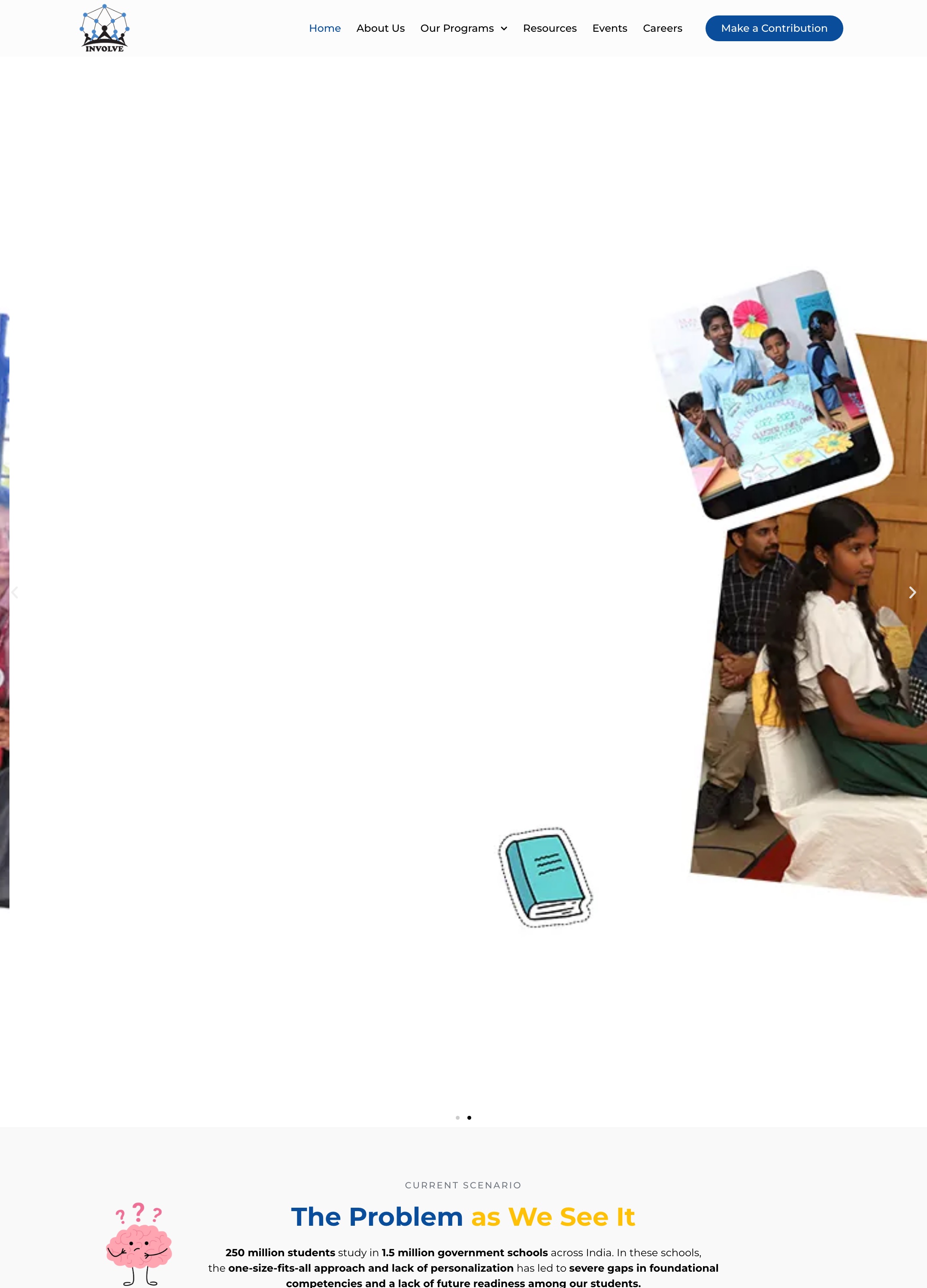
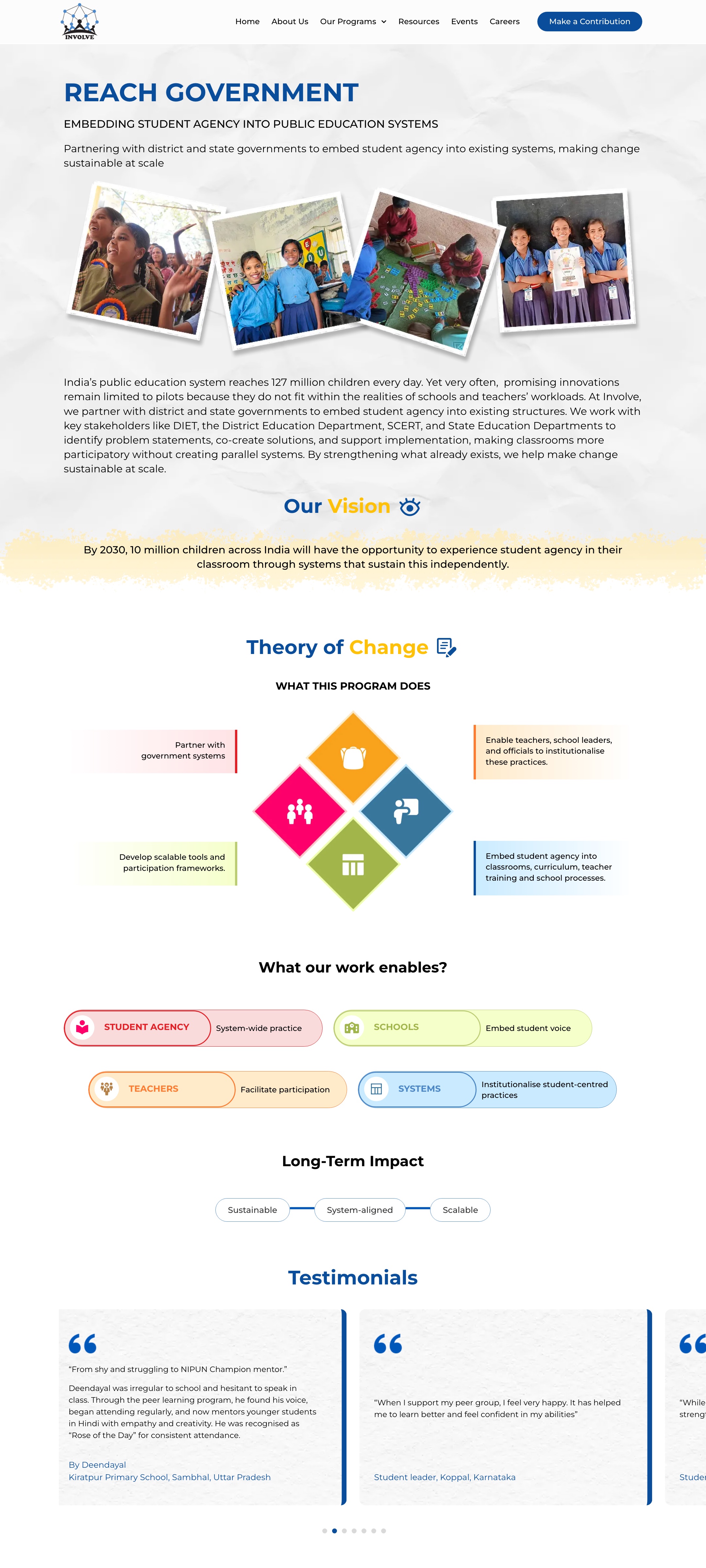
Involve talks to four different audiences — a district education officer, a funder's programme officer, a prospective employee, a donor — and that was the main design problem. Each section leads with what its audience cares about first. On the stack: the public site runs on WordPress, deliberately, so Involve's communications team can publish constantly without calling us. The engineering effort went into the internal tools, where it changes what the organisation can actually do.
The teaching-material generator
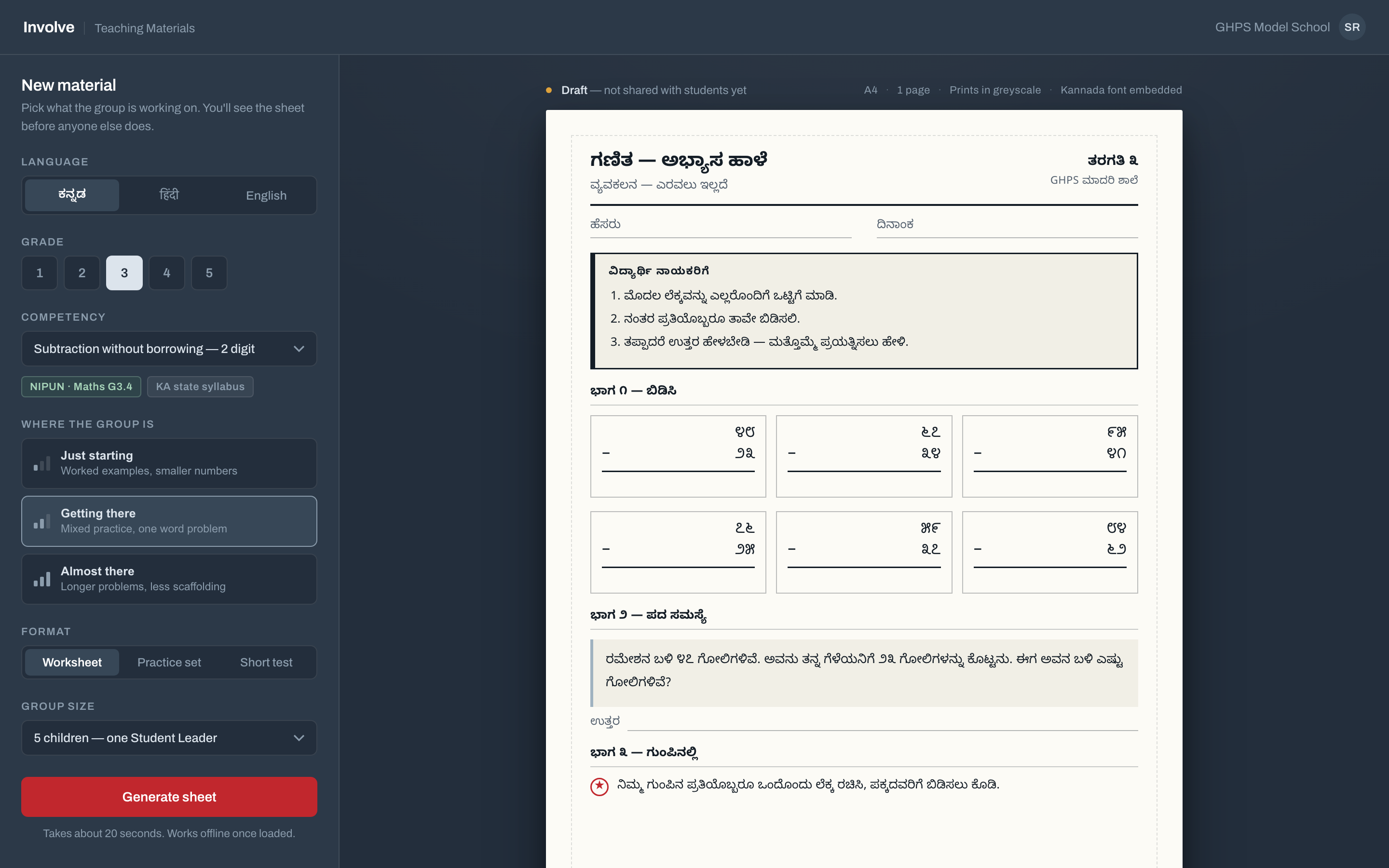
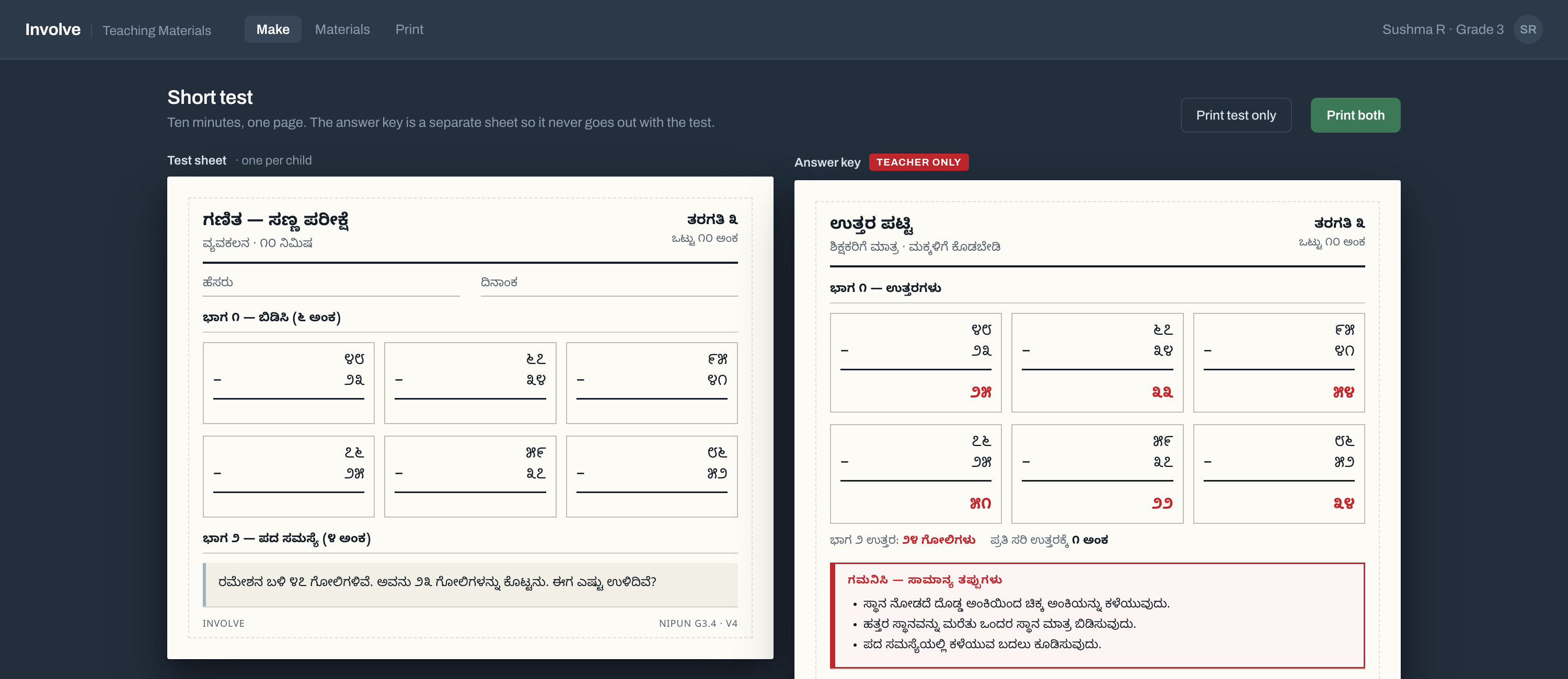
Teachers in these schools need worksheets, practice sets and assessments constantly — matched to the right grade, the right competency and the right language. Producing them by hand takes time nobody has. So we built a tool that generates them on demand.
Five decisions that shaped this tool
Output is print-first
Most classrooms don't have a screen to display things on. The preview is a real A4 page at true proportion, with the print margin shown — one page, prints in greyscale, Kannada font embedded.
Kannada and Hindi are first-class, not translations
Content is generated in the language of instruction rather than written in English and translated after, which produces stilted material and mangles maths vocabulary. Numerals switch too — ೪೭ in Kannada, ४७ in Hindi.
It maps to competencies the state already uses
The NIPUN tag on the competency, and again in the sheet footer, means a teacher working to NIPUN targets doesn't have to translate between two systems.
Difficulty is described the way teachers think
Not Easy, Medium, Hard — Just starting, Getting there, Almost there. Teachers think about where a group has got to, not about abstract levels.
The teacher reviews before anything reaches a child
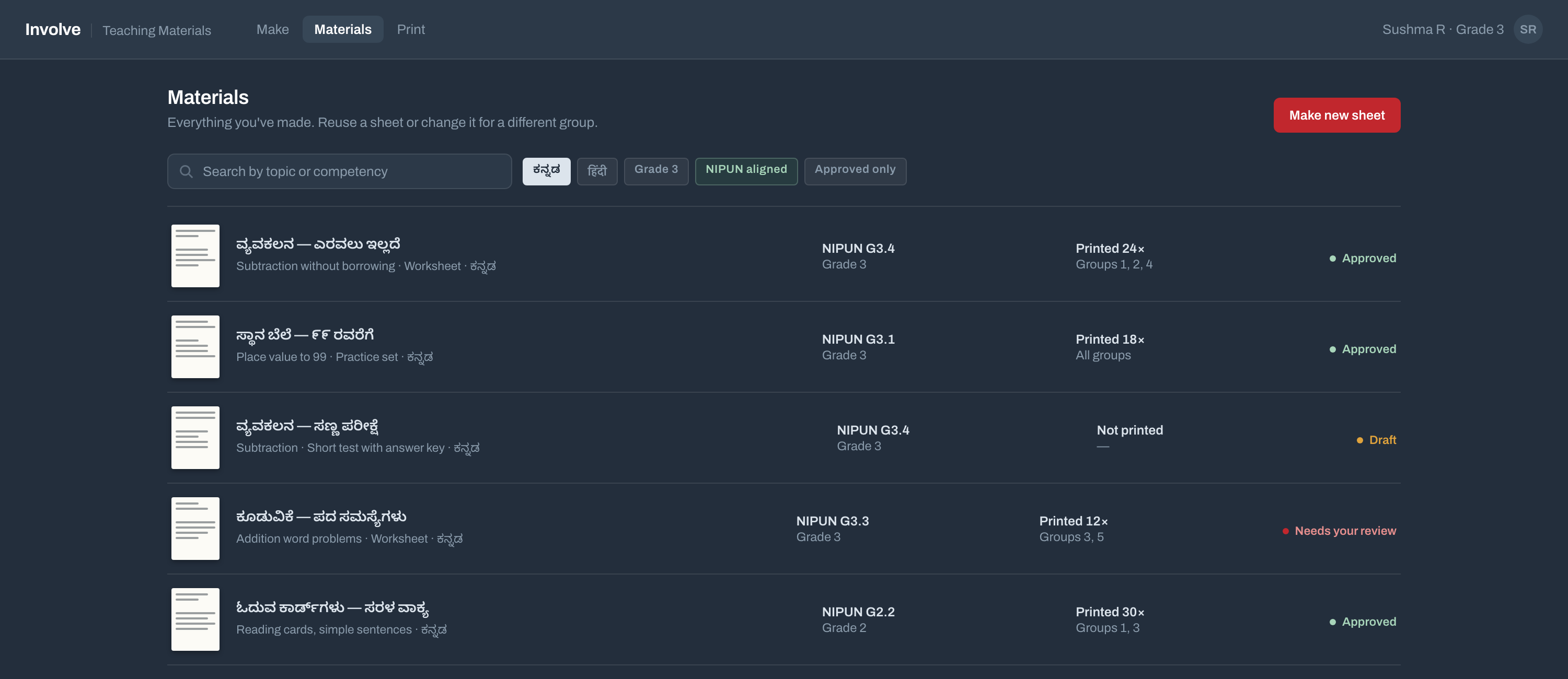
Nothing auto-publishes. Generated material stays a draft, marked clearly as not shared with students, until the teacher approves it. The tool proposes, they decide.
Every sheet carries an instruction box addressed to the Student Leader, not the teacher — do the first sum together, then let each child solve on their own, and if they get it wrong don't give the answer, ask them to try again. These are twelve-year-olds teaching eight-year-olds, and the material has to work in their hands.
The internal operations platform
The management team runs programmes across thousands of schools in three states. Before this, that coordination lived in spreadsheets, WhatsApp groups and people's heads.
Goal tracking
Organisation-level goals cascade down to programme, state, district and block targets. The point is seeing, mid-quarter, which level of the tree has stopped moving.
Case management
Individual issues that need following up and closing — a school where sessions have stopped, an escalation, a coordinator flagging a problem. Each case now has an owner, a status and a history.
Field programme management
Which schools are active, who's covering them, when they were last visited, what was recorded. Coverage gaps are invisible until you can see them laid out.
Community-based interventions
Makkala Grama Sabha, Bal Sansads, Dream Design Do — work that runs on a different rhythm to classroom programmes, tracked in its own shape rather than forced into one.
Screenshot pending: goal tracking, cascading from organisation level down to block.
Built around exceptions. The first version showed big aggregate numbers and trends. An average across thousands of schools moves slowly enough to look healthy while one block quietly stops running sessions entirely. What a programme lead needs first thing in the morning isn't "how are we doing" — it's "where is something going wrong right now." So the default view is what's broken: stalled schools, overdue cases, coverage gaps, groups that lost their Student Leader to a transfer. The headline numbers are still there for funder reporting, just not on the front page.
Screenshot pending: field programme view — coverage across schools and blocks, with the gaps surfaced rather than averaged away.
What was hard
Case studies that only contain wins are advertisements.
Building for phones and printers we don't own
It has to work on a three-year-old Android in a school with intermittent signal, and print legibly on a machine low on toner. Most early problems traced back to that gap, and the fix was unglamorous — test on the real devices in the real conditions.
Getting the languages right
Kannada and Hindi strings run longer than English, and Devanagari needs more vertical space. Font support on budget Android is inconsistent enough that Kannada text renders as boxes on some devices unless you bundle the fonts yourself.
Knowing what not to automate
The obvious request was a tool that assigns Student Leaders to groups automatically. We built it to suggest groupings and flag problems instead, leaving the decision with the teacher — an algorithm quietly assigning children to each other would have contradicted the thing the software exists to support.
Where AI fits
The teaching-material generator is the AI system here. The rest of the platform is deliberately conventional software — in a programme being evaluated by external researchers, a model in the wrong place undermines the evidence.
What we use it for
Generating teaching materials and assessments
Structuring the free-text observations field staff write in Kannada and Hindi, so patterns across a block become visible
What we deliberately didn't do
Nothing generated reaches a child without a teacher approving it
Nothing touches outcome measurement — no predicted scores, no filled-in missing assessments
If a learning gain has a model anywhere in its history, it stops being usable as evidence — and Involve's whole position depends on their evidence holding up. Their reported learning gains come from eight years of curriculum design and delivery by teachers and coordinators; the software supports that work, it didn't cause it.
Nonprofits usually get offered one of two things: an agency that builds a nice website and disappears, or volunteers who build something nobody can maintain. Neither survives a programme that reports to a state government and a research university in the same quarter. We build things that hold up. If that's your problem, let's talk.
Ready to Get Started?
Book a free discovery call and let's explore how Dev can accelerate your business with AI-first solutions.
🍪 We use cookies
We use cookies to analyze site traffic and improve your experience. No personal data is sold.